Thứ Bảy, 24 tháng 10, 2015

Lai Thieu pottery- making village

Binh Duong Province is located in the eastern part of South Vietnam, with the town of Thu Dau Mot only 30 km south of Ho Chi Minh City. The province covers an area of 2,716 km2 of highland between the Sai Gon and Dong Nai Rivers and it has a population of 743,000. In the Binh Duong province is a network of traditional craft villages spreading all over the province, specializing in ceramics, lacquers, sculpture, brass castings, etc. Its ceramic industry have for generations produced a great diversity of ceramics and outdoor pottery wares.

Ceramics production appears to have originated in Binh Duong in the 18th century. Around the beginning of the 20th century, the Lai Thieu region of Binh Duong province emerged as South-East Asia’s central ceramics market due to its accessibility from both land and river. Its importance grew with the arrival of some Chinese potters that came to Binh Duong on trading ships and saw the potential in the available natural resources as local clay, large tree reserves available for firewood and the huge kaolin deposits that could be easily mined. The immigrants from China stopped in at Lai Thieu and built pottery kilns, and local workers and artisans gathered here to produce ceramics items.

However using Chinese technique and very influenced by the Chinese the Vietnamese potters did not copy Chinese ceramics directly; they combined elements in original ways, experienced with new ideas and adopted features from other cultures such as Cambodia and Champa.
Binh Duong ceramic featured a vast range of decorative motifs. Besides the traditional blue pattern ceramics, a new style soon became famous under the name of Lai Thieu cock-figured pottery. It was mostly items for household use such as bowls, dishes, teapots and cups, cooked rice containers with dome shaped tops, bottles, etc.

Decorative patterns were drawn on the glaze in both elaborate and free styles usually using three colours, either crimson red, green and black or, red, black and indigo. Popular motifs were a cock, a banana tree or a bunch of chrysanthemums while other patterns included flowers and birds, or leaves and landscapes. Binh Duong ceramics remained a kind of porous earthenware, with mostly whitish (ivory-white) glaze.With time, decorative motifs carried on developing due to the demands of domestic as well as foreign customers.

Binh Duong’s ceramics are fired in chambered and pipe-typed kilns. Through time, products, kiln technology and production processes steadily improved as Binh Duong potters went through successive stages of modernization and mechanization in order to increase productivity as well as the quality of their products.

Lai Thieu pottery from the last century is said to be a fusion of three lines of the southern Chinese ceramics – those from Chaozhou, Guangdong and Fujian. The Chaozhou line includes household commodities like bowls and plates decorated with the images of Bat Tien (the Eight Fairies), or the legendary stories of Chaozhou. The Guangdong line comprises of ornamental pieces including vases and flower pots, while the Fujian line includes vases and small jars which are enameled and painted brown.

In Vietnam, The Lai Thieu and Southern Household Pottery exhibition, featuring around 639 pieces, was displayed at the HCMC Museum of Fine Arts until the end of May, 2009. Currently, Minh Long 1 Co pottery (also in Binh Duong) is produced using advanced technology and sophisticated equipment.
Van Diem carpentry village

Van Diem belongs to Thuong Tin District, 20km South from Hanoi. It is an area of longstanding traditional woodwork trade, with wood carved products of high quality. This carpentry in Van Diem came into existance in the still unknown, may be it is because of life requirement people of van Dien learn this profession from somewhere else and then impart to each other.

As time, when by Van Dien people with their skillfull hand and traditional know how has brought the carpentry to a very hight grow lever, they suplier hight quality produce with good aesthetic value which well meet the country demand as well as that of foreign countries.

The industry was developed owing to antique dealers and secondhand repairers learnt acknowledge. Afterwards, thank to increasing demands, the hamlet's woodwork industry has been significantly developed.  In addition to lacquer painting and fine arts encrusting, woodwork is a traditional industry bring high income for home craft households.

Thank to woodwork industry, villagers living standard is not only food and clothes but also targeted forbest food and beautiful clothescontributing to the cause of building rural areas modernized, civilized and cultural. It can be said that Van Diem trade village's super quality woodworks have been meeting demands and requirements of the most fastidious customers.  In parallel with that, the traditional woodwork industry is also a national fine arts beauty when introduced to world markets such as Taiwan, Hong Kong, Japan, etc.
My Nghiep weaving village

The traditional craft of weaving brocade has existed for hundreds of years in My Nghiep Village, Phuoc Dan Town, Ninh Phuoc District, Ninh Thuan Province. Over the years, the local people have maintained techniques on weaving brocade according to the traditional method that helps preserve the Cham cultural features.

According to locals, artisan Ponuga is the founder of the craft that was then handed down to the Cham people in Ca Klaing (present-day My Nghiep) Village. 

Previously, to have the materials for making brocade products, it took the locals much time and effort to grow cotton plants, take the fibres, dry and dye them. 

They used Chum bau leaves for dyeing and then soaked it into mud for seven days to create the black colour, the latex of Canh kien plants in the forest to create the red colour and leaves and barks of indigo plants to create the indigo-blue colour. However, all the materials, from fibres to artificial colourings, are now available in the market, facilitating the craft of locals. 

Among the steps of weaving brocade, the most difficult one is blending the colours for patterns that require the artisans’ aesthetic sense and experience. For the step of weaving, the weavers must manipulate the threads in a harmonious way so the brocade will be flat with striking colourful patterns. Each brocade made by My Nghiep villagers is different from others in terms of patterns, motifs and designs even though they are made by one weaver. 

It is the unique feature of My Nghiep brocade products. On the background colours of red and black, the typical colours of Cham brocade, are diverse patterns, such as basic geometric shapes, clouds, dragons and animals. The patterns on the Cham women’s costumes also reflect their position and class in society.

The brocade weaving craft has been preserved and developed by the Cham people in not only My Nghiep Village, but also in Huu Duc, Chung My and Van Lam in Ninh Thuan and other villages in Binh Thuan Province. In other villages only women engage in the craft whereas both men and women in My Nghiep practice the craft. 

Besides traditional products, the My Nghiep villagers now make different products, such as bags, purses and backpacks which are sold in the domestic market and exported to Japan, German, France and the US. The craft has provided jobs for local people, improving their living standards.
 
To further develop the craft, artisans in the village pay much attention to creating new, unique patterns to meet the demand of customers while young people start promoting and introducing their products in Ho Chi Minh City and other provinces nationwide.

Thanks to their high quality, the products of My Nghiep Village have won many great prizes both at home and abroad and artisans are invited to participate in many trade fairs and exhibitions in China, Thailand, France and Malaysia. The village is also recognized by the Vietnam Handicraft Villages’ Association.


Van Ha carpentry village

Self-turning tables can now be reproduced by carpenters at an ancient carpentry village in the central Vietnamese province of Quang Nam.This was once the traditional product of Van Ha Village in Tam Thanh Commune of Phu Ninh District. But it had disappeared for decades long before young artisans studied to restore the techniques to make the product.

Without using any ball bearings or metal sheets, the table faces can turn around thanks to their special design.A big pillar decorated like a flower vase is vertically placed on a joint of three legs below.

The table face is then placed atop the pillar, as illustrated in pictures attached to this story show.
The turning of the face is based on techniques, not magic or wizardry as rumored before.
To make the table face able to turn round with minimum force, a depression must be made at the exact center on its back side to smoothly match with the top part of the pillar of the table.
It still requires some more tricks and secrets that were not revealed by carpenters to make the table face sensitive to a minimum force, such as the placing of human palms on it.

Before, it was rumored that the table face turns clockwise if one or more people place their palms on it for three seconds, and it turns counterclockwise if palms are placed upward on the table face.

In short, placing either side of your hands is the force needed to make the sensitive table face turn around, and determining the direction is based on the psychological factor of the people impacting it.
Senior carpenter Dinh Tham, now in his 90s, is credited as the authentic restorer of the ancient wood tables of Van Ha Village.

The village, which is believed to have been established in the 14th century, produced wood tables of this design centuries ago, and the last one was made 70 years back.However, Van Ha carpenters at that time did not know that the tables could turn around by placing hands on itThe fact was randomly uncovered by users in the 1990s when the techniques of creating the tables had faded with the passing away of skilled carpenters.Then, they were rumored as magic self-turning tables.

In 2012, Tham was asked by clients to repair two ancient tables his father had made decades earlier. Tham managed to discover how to make the tables turn around.

He transferred ‘the technology' to the two most experienced young carpenters in the village, Pham Mien and Tran Ngoc Tuan.
Currently, they can create new tables, with new wood pieces, with turning table faces. Before, it was believed that only ancient timber could make it turn around.
In 2013, Tham and his young artisans introduced their products at an exhibition in Tam Ky City of Quang Nam Province.

Now, the turning tables of Van Ha Village are well known across the nation and many families wish to own such a table made with ancient techniques, even though they are much more expensive than a normal one.New self-turning tables are presently carved with complicated decorations.

Tham said that all self-turning tables that were advertised as magical ancient furniture were produced by Van Ha carpenters. The oldest such table left till now is over 200 years old.This was because the special design was owned by Van Ha carpentry village, he added.Tham and his colleagues in Van Ha have sold dozens of tables across the nation.

Le Van Chuong, vice chairman of the People’s Committee of Tam Thanh Commune, admitted that the restoration of the tables is thanks to the contribution of Dinh Tham and other skillful carpenters in Van Ha.

Nhat Tan flower- planting village

Nhat Tan flower village is 7km northwest from the centre of Ha Noi and is famous for its peaches and grows many different kinds with each offering their own distinct beauty. 

Nhat Tan peach is a flower that is integral to the Tet traditions of Vietnamese people. Around Lunar December 20 of each year, Nhat Tan villagers usually cut a peach branch to sell at Ngu Xa, Hang Luoc, Quang Ba flower markets for people to show at Tet. 
On massive fields by the bank of the Red River, farmers are taking care of peach trees and protecting them from cold spells so that peach flowers can bloom at the right time.
To have peach trees blossoming for Tet holiday, gardeners have worked hard for a whole year. In addition to peach blossoms, Nhat Tan farmers also plant seasonal flowers. 
On the edge of Hanoi’s West Lake, the flower village is blooming with various flowers such as chrysanthemums, globe amaranths, honeysuckles, carnations and especially pink peach. Nhat Tan may not the largest flower fair in Hanoi, but still offers some great sights. Every spring, visitors flock to Nhat Tan village for peach blossom gardens where they can bathe in the red and pink blooms, which symbolize prosperity, life and love in Vietnamese culture and soak up Tet’s atmosphere.

Nhat Tan peach garden is the destination of the majority Hanoians and surrounding areas those who wish to marvel at and smell peach blossoms when the weather gets a bit cool. About hundreds of ornamental peach trees make gardens perfumed with romantic blooms and intoxicating fragrances, and extremely colorful.
In less than a month until the Lunar New Year, Nhat Tan flower village becomes more thrilling than ever. The peach flowers bloom and show off the beauty, not only attract people to buy flowers, visit and photograph.

Thứ Sáu, 23 tháng 10, 2015

Tay Ho conical hat making village

The Tay Ho village is the hometown of the Hue conical hats- a thing is considered as the beauty of Hue’s soul.Located near Nhu Y river, the Tay Ho village (Phu Ho commune, Phu Vang district, Thua Thien-Hue province) has long been well-known for traditional conical hat making craft. The conical hat making craft has established for 100 years and poem conical hats – a typical feature of Hue also originates from Tay Ho village ( the land has been famous for beautiful girls).

The poem conical hat was first made in Tay Ho village by accident. In period 1959- 1960, Mr. Bui Quang Bac- a craftsman of making conical hats and also a poetic lover in the village who had an idea to make the poem conical hat by adding poems between two layers of leaves, highlight the beauty of the conical hats (at that time, Hue conical hats were mainly sold to Southern market).
The first two verses are pressed into the conical hat by Mr. Bac:“Who visit poetic Hue, buy the conical hat as the gift”

Women in Tay Ho village at the age of 10 learn to make conical hats by themselves and some people spend their whole life to make this traditional craft. To men, apart from farming, they help women iron leaves or cut bamboo to make frames. A kind of bamboo, they sophisticatedly polished bamboo strands into 16 strands; then bend them into round rings. To get beautiful leaves, craftsmen often choose leaves remaining light blue, iron leaves many times until flat and smooth. After that leaves will attached to the frame. This stage is called “cham,” which is usually made by young girls.
Hue’s conical hats are famous thanks to this stage. Hue’s conical hats always have two layers of leaves. Craftsmen must be very skillful to make the two layers very thin. After this stage, the hats will be covered by oil and dried under the sun.

At first time, the poetic conical hat was made to present relatives, but after that it is preferred by a lot of people. Since then, craftsmen have started to produce the poetic conical hat for sale. The verses which are pressed into hats are more diverse. They usually are verses of Hue.

Moreover, to make the hat more beautiful, craftsmen also add paintings of Perfume river and Ngu mountain next to verses. Over quite long time, the poetic hat is proprietary products of Tay Ho village.
Cam Ne sedge mat village

Cam Ne Mat Village is located in Hoa Tien Village, Hoa Vang District, Danang City.Ne Mats were used in the royal palace of Nguyen Dynasty. The artists of Cam Ne Village were honored and rewarded by the Kings. 

According to the old people of this village, mat craft is originated from Hoang Hoa, Thanh Hoa Province. It was handed down to the people in the south in the 15th century when Le Thanh Tong won Chiem Thanh and merged Do Ban into Quang Nam - Danang. From that moment till now, having suffered from the ups and downs, the separation of the war, the competition of the imported nylon mat, Cam Ne Village still exists peacefully. 

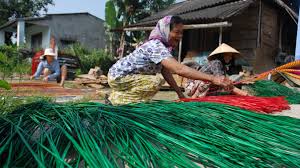
Mat makers require skilful hands and an artist's eye to create these beautiful and quality products.  Sedges are cleaned, dyed in various colours, and then dried under the sun.  Then they are soaked in water to become soft before they are used to make the mats.  Once produced, the mats are cleaned and made smooth before sale.

With the raw materials like sedge, and the delicate knitting frame, the artists of Cam Ne have made many flowered sedge mats of all sizes with beautiful designs to meet the demands of the market in the north and the south. The Cam Ne mats is much thicker, better, softer than the ones in other places. Especially in the hot summer, lying on the Cam Ne mats, you will feel cool, and in the winter, you will feel warm with the pure fragrance of sedge. 

The flowered sedge mat in Cam Ne village is not weaved to become the smooth sedge mat and using to  print the flower in the background as some areas which choose the sedge to dye, the color depending on the owner, such as red, blue, green, yellow,… The pigment is cooked and dips a group in the pigment and expose to the sun. A handful of sedge can dye one or two or three times, depending on the color of pigment and the dark or light of color when preparing. The colorful sedge after dried, it is used to weave the flowered sedge mat.

The labor of weaving the sedge mat is choosing the tree to make the loincloth and diamond-shaped. The trees are straight, light and strong. In Cam Ne village, people often use the old areca to make the loincloth. There are two people, a person keeps the loincloth and another person keeps the diamond-shaped., weaving in ten hours has 1,5 or two couples of the sedge mat, depending on the type: the smooth or flowered sedge mat and the size: large or small. Exposing the weaved sedge mat to the sun and pinning the jute is the last step. This work requires the skillful people.

The product made, is consumed at the village through selling and buying. The cost is various depending on the size. The Cam Ne sedge mat’s strengths are more careful, thick, strong and smooth than the different areas. Nowadays, the Cam Ne sedge mat village is difficult with the competitiveness of the market economy. To conserve and prove the traditional sedge mat of Cam Ne, people help to share the experiences, capital. And especially, the products are prestigious in the model, quality and the effect. It just exists and develops.