Hiển thị các bài đăng có nhãn Sedge mat villages. Hiển thị tất cả bài đăng

Thứ Tư, 4 tháng 11, 2015

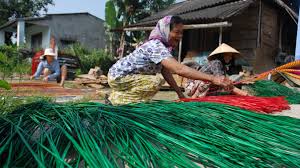
Duy Vinh sedge mat village


Being created by alluvium of three rivers Thu Bon, Trung Giang and Ly Ly, Duy Vinh commune (Duy Xuyen district, Quang Nam province) has been famous for a long time of weaving sedge mats. The profession of weaving sedge mat was derived from Nga Son – Thanh Hoa province, and introduced into Quang Nam in early 14th century. 
Duy Vinh sedge mat village

Sedge grass is the main material in mat weaving; it is easy to grow in this land and gives high productivity. There are many kinds of mat like plain mat, colored mat, embossed mat…; therefore depending on the intended use of each one, farmers will harvest sedge in many different sizes. After being harvested in July and August every year, sedge will be dried, dyed by color ink and stored for weaving all year round. Many clients come to Duy Vinh to buy sedge mats or they will be sold at Ban Thanh sedge mats market.
Duy Vinh sedge mat village 2

Duy Vinh craft village has 350 households, 300 of which have weaved sedge mats from generations to generations and supplied nearly 10,000 pairs of sedge mats each day to the market. The weaving process requires two people, one is the designer for the pattern by controlling the jutes up and down rhythmically, the other is responsible for inserting the sedges into the space between jutes. This work requires patience and experience to make a perfect work. From the yarns of green, red, purple, yellow sedge ... with brain and heart, the weavers have created hundreds of perfect color mixing picture.

In many years before, this product was very hard to consume and heatly competed by industrial produced mats. However, some years recently, many people returned to use sedge mats; that helps to resuscitate this valuable traditional occupation. Duy Vinh mats craft village is not only creating job for local residents but also an attractive destination of worldwide tourists

Thứ Sáu, 23 tháng 10, 2015

Cam Ne sedge mat village

Cam Ne Mat Village is located in Hoa Tien Village, Hoa Vang District, Danang City.Ne Mats were used in the royal palace of Nguyen Dynasty. The artists of Cam Ne Village were honored and rewarded by the Kings. 

According to the old people of this village, mat craft is originated from Hoang Hoa, Thanh Hoa Province. It was handed down to the people in the south in the 15th century when Le Thanh Tong won Chiem Thanh and merged Do Ban into Quang Nam - Danang. From that moment till now, having suffered from the ups and downs, the separation of the war, the competition of the imported nylon mat, Cam Ne Village still exists peacefully. 

Mat makers require skilful hands and an artist's eye to create these beautiful and quality products.  Sedges are cleaned, dyed in various colours, and then dried under the sun.  Then they are soaked in water to become soft before they are used to make the mats.  Once produced, the mats are cleaned and made smooth before sale.

With the raw materials like sedge, and the delicate knitting frame, the artists of Cam Ne have made many flowered sedge mats of all sizes with beautiful designs to meet the demands of the market in the north and the south. The Cam Ne mats is much thicker, better, softer than the ones in other places. Especially in the hot summer, lying on the Cam Ne mats, you will feel cool, and in the winter, you will feel warm with the pure fragrance of sedge. 

The flowered sedge mat in Cam Ne village is not weaved to become the smooth sedge mat and using to  print the flower in the background as some areas which choose the sedge to dye, the color depending on the owner, such as red, blue, green, yellow,… The pigment is cooked and dips a group in the pigment and expose to the sun. A handful of sedge can dye one or two or three times, depending on the color of pigment and the dark or light of color when preparing. The colorful sedge after dried, it is used to weave the flowered sedge mat.

The labor of weaving the sedge mat is choosing the tree to make the loincloth and diamond-shaped. The trees are straight, light and strong. In Cam Ne village, people often use the old areca to make the loincloth. There are two people, a person keeps the loincloth and another person keeps the diamond-shaped., weaving in ten hours has 1,5 or two couples of the sedge mat, depending on the type: the smooth or flowered sedge mat and the size: large or small. Exposing the weaved sedge mat to the sun and pinning the jute is the last step. This work requires the skillful people.

The product made, is consumed at the village through selling and buying. The cost is various depending on the size. The Cam Ne sedge mat’s strengths are more careful, thick, strong and smooth than the different areas. Nowadays, the Cam Ne sedge mat village is difficult with the competitiveness of the market economy. To conserve and prove the traditional sedge mat of Cam Ne, people help to share the experiences, capital. And especially, the products are prestigious in the model, quality and the effect. It just exists and develops.
Ban Thach sedge mat village

The Ban Thach sedge mat village in Quang Nam Province has been well-known by locals for a long time, but only recently has it been discovered by tourists.The harmoniously-coloured sedge mats woven by villagers in the off-time after the harvest are now being marketed out of the commune and all over the country.

With abundant sources of raw rush and jute, the materials used to weave mats, Ban Thach villagers have succeeded in developing their own handicraft and improving their lives.There are many categories of Ban Thach sedge mats, all of them different in colour or design. From solid colours to intricate flower designs, each is woven by a craftswoman with her own technique and source for materials.

Craftswoman Nguyen Thi Tien, 60, has spent most of her life honing her skills. The grandmother of four has never left Ban Thach Village.When asked how long she has been weaving sedge mats, she smiled. "I, like 90 per cent of Ban Thach villagers, have had this job passed down to me by my ancestors."A 6-year-old child can begin learning how to weave mats," she added.

The job requires little initial capital and it’s perfect for farmers with idle time after the harvest. Women love the chance to gather together to weave and chat about life.All the separate processes of mat weaving are set out clearly. The men are in charge of cutting down the rush or jute plants, drying them in the sun and stripping away the bark, while the women dye and weave the mats. A woman is usually able to weave between three or four mats a day.

Most of the weavers in this village sell their products to traders or street vendors in neighbouring provinces.Weavers spend most of their time on the intricate patterns and colours. The most important step in the process is to dye the rush fibre after it has been stripped and dried in the sun.

Thứ Năm, 22 tháng 10, 2015

Kim Son sedge mat village

For a long time, Kim Son District in Ninh Binh Province has been well known for growing sedge plants and the craft of making sedge handicraft products which are exported to over 20 countries and territories around the world.
Visiting Kim Son one day in June, you will enjoy the slight sweet aroma of sedge flowers mingled with that of ripe rice paddies. According to the elders in the region, sedge plants appeared in Kim Son two decades ago. After over hundreds of years, the Kim Son villagers have created immense alluvial grounds for growing sedge. 

When the Vet (Bruguiera) plant is in blossom on coastal alluvial grounds, the season of harvesting sedge starts. The fresh sedge plants are thinly split, chopped and dried before being given to mat weaving villages in the region. Previously, Kim Son villagers only made mats from the sedge. However, they now make different fine handicrafts for export.

In 2011, Kim Son District had a total area of 384,3ha for growing sedge plants with two seasons of crops. The production of split and dried sedge has reached 3,125 tonnes/year. The whole district produced over 23,000 handicraft products of different kinds. 

So far, the district has 23 sedge making villages and dozens of small and big businesses, which serve as a bridge between these craft villages and foreign markets. They also have trained over 800 skilled workers, not only meeting the demand for labour of the district, but also the neighbouring provinces of Thai Binh, Nam Dinh and Thanh Hoa. 

Do Nhu Phong, Director of Nang Dong Sedge Producing Enterprises in Kim Son, said that despite the economic decline, the productivity of handicraft products in Kim Son annually increases and are much sought after in markets, bringing workers a stable income of about 2-3 million VND/month.

The sedge handicrafts made in Kim Son are one of the favourite products in foreign markets because they are made from natural materials and are eco-friendly, durable, beautiful, diverse in styles and colours and sold at a cheap price.

To make a beautiful sedge handicraft product, meeting standards for export, it requires special techniques in sedge growing and production. It is a precise, detailed process, from the first step of growing and then harvesting, selecting, splitting, drying and dyeing sedge to the last step of weaving and completing the products. 

The technique for using Polyascera glue to spray over the surface of the product helps create the form for the product and increase the resistance to mould and damp during the process of transporting by sea to foreign markets. For this reason, Kim Son sedge handicrafts always ensure quality and help increase competitiveness in the international market. 

To have beautiful designs that meet the different tastes of customers, the enterprises cooperate with partners on designing products. They then send the orders to artisans in craft villages. When sample products are made well, they will instruct and transfer the techniques to households to produce in mass. The products are finally checked by the enterprises before being sold to the market.

The enterprises not only learn about the markets, but also how to combine traditional techniques with advanced technologies in production. Therefore, their products meet all the demands of all partners.

So far, Kim Son sedge products have been exported to over 20 countries and territories around the world. It is expected that the trademark of Kim Son sedge products will become more popular in both domestic and foreign markets.
Nga Son sedge mat village

Many people may have never come Nga Son, even once, but a long tool to give Huu brought many unique features of Russia Son: That projection profession. Nga Son has 8 villages along the coast have a long tradition of weaving straw mats doi.Tu ancient Russian premiere Son, Kim Son Thang Long was known kings. In the palace, the palace, in the hope Career notable ethnic Russian mats Son is another convincing evidence for the wealthy, sophisticated level of bourgeois citadel. Seductive beauty of the Russian premiere was the shining polished paint, soft. Nowhere more Nga Son sedge with tiny fibers, so long and soft. Nga Son can create many types of projectors. Superiority was hardly equaled anywhere. So specific products made from the hands diligence, ingenuity of the Russian people are to every domain Son. 

Today the brand "Russian premiere Son" has addressed many countries harbor sedge preferred. But the rush of today not only creates special projector. From Nga Son sedge has created many other attractive products: tourism projection two fold, three-fold, four-fold convenience, fruit basket, lane, per box with a lid, padded ... elegant styling, young Mid. Among trading partners, Japan proved earnest with the rush. Since many years ago, Japanese firms have come Nga Son, close links with over 50 export enterprises rush of 8 coastal communes. Nga Son sedge now have extensive trade corridor to many countries. Mat making by hand crafts, obviously this traditional craft. This is an opportunity for Russia Son craftsmen show enough talent on each plate sedge. 

In the coastal district of Thanh Hoa province, Nga Son has been known for its beautiful sedge mats for centuries. Most Vietnamese know well the idiom, “Nga Son mats, Bat Trang ceramics” which signifies the popularity of these two locations.

There are many provinces planting sedge for mat making and various kinds of handicraft, but sedge in Nga Son is always considered best quality because of its soil condition. The sedge is not only long but also naturally white and free from black spots caused by stem borers. 

Thousands of farmers engage in various stages of mat making, from spining, dyeing and drying, to weaving. Many co-operatives and enterprises like Viet Trang, Nga Son were established with hundreds of workers busily weaving beautiful mats in large workshops. 

In recent years, Nga Son mats have also had competition from artificial plastic mats flooding the markets, but these can never take the place of authentic sedge mats. Cool in summer and warm in winter, Nga Son mats ventilate well and smell of nature, linking their users to an age-old tradition and heritage.